


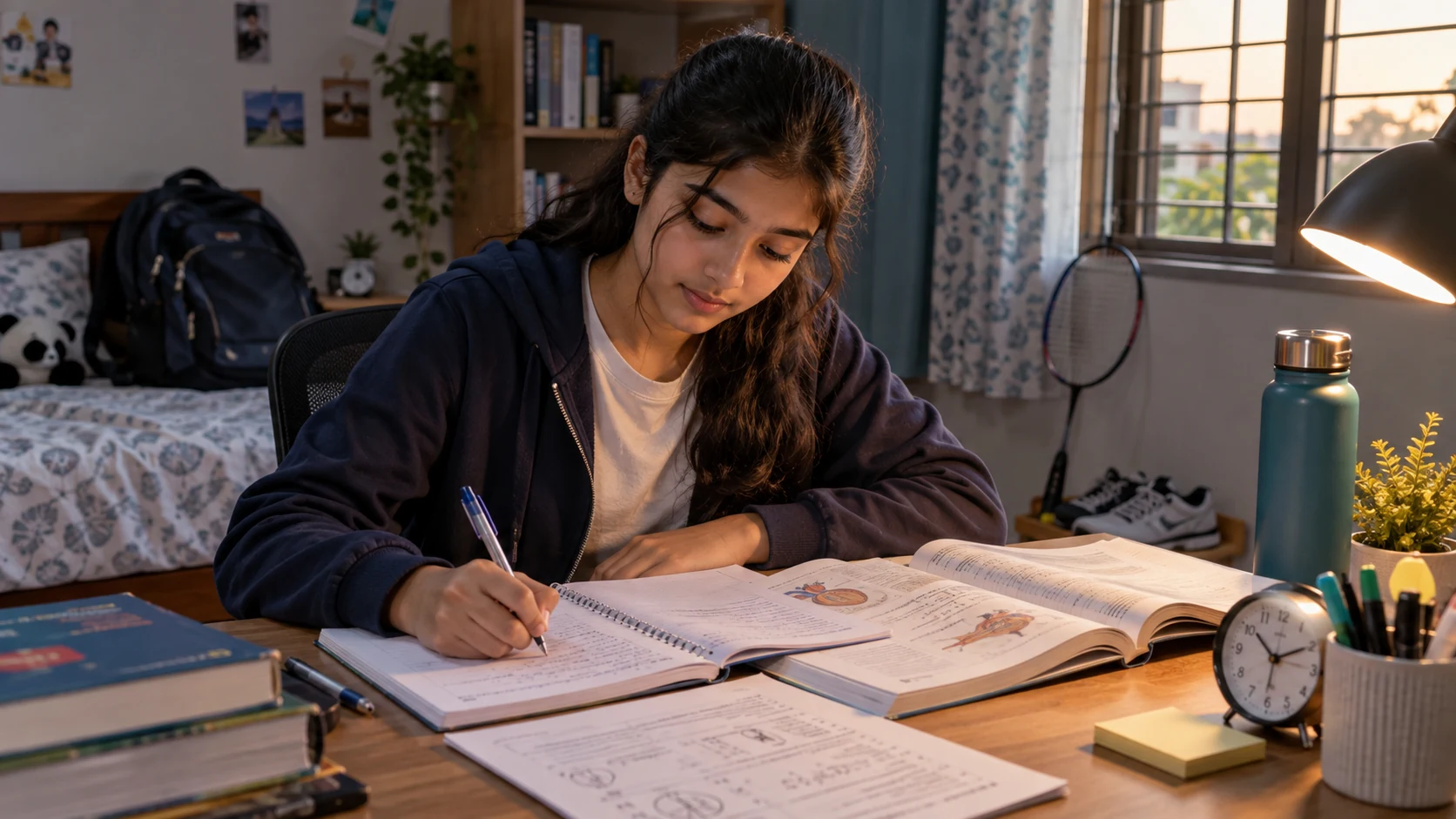
Preparing for NEET does not happen in an empty day. A Class 11 or 12 student already has school, homework, assignments, school tests, practical work and family responsibilities. Some students also attend coaching. NEET preparation then adds more learning, question practice, revision and tests to an already busy week.
There is no single timetable that can answer these questions for every student. School timings are different. Travel times are different. Some students attend coaching and others do not. One student may concentrate well for an hour, while another may work much better in shorter periods.
Effective preparation is therefore not simply about finding more hours. It is about making good use of the time you already have, connecting school learning with NEET preparation, using tests to decide what needs attention, and keeping your mind and body healthy enough to continue doing this over many months.
Our earlier article, How to Know If You Are Well Prepared for NEET, explains how to judge preparation. Here, the focus is on fitting continuing preparation into regular school and everyday student life.
ONE CONNECTED LEARNING ROUTINE
Let school and NEET preparation work together
School preparation and NEET preparation do not always need to be treated as two completely separate workloads. Suppose your Physics class is studying Laws of Motion.
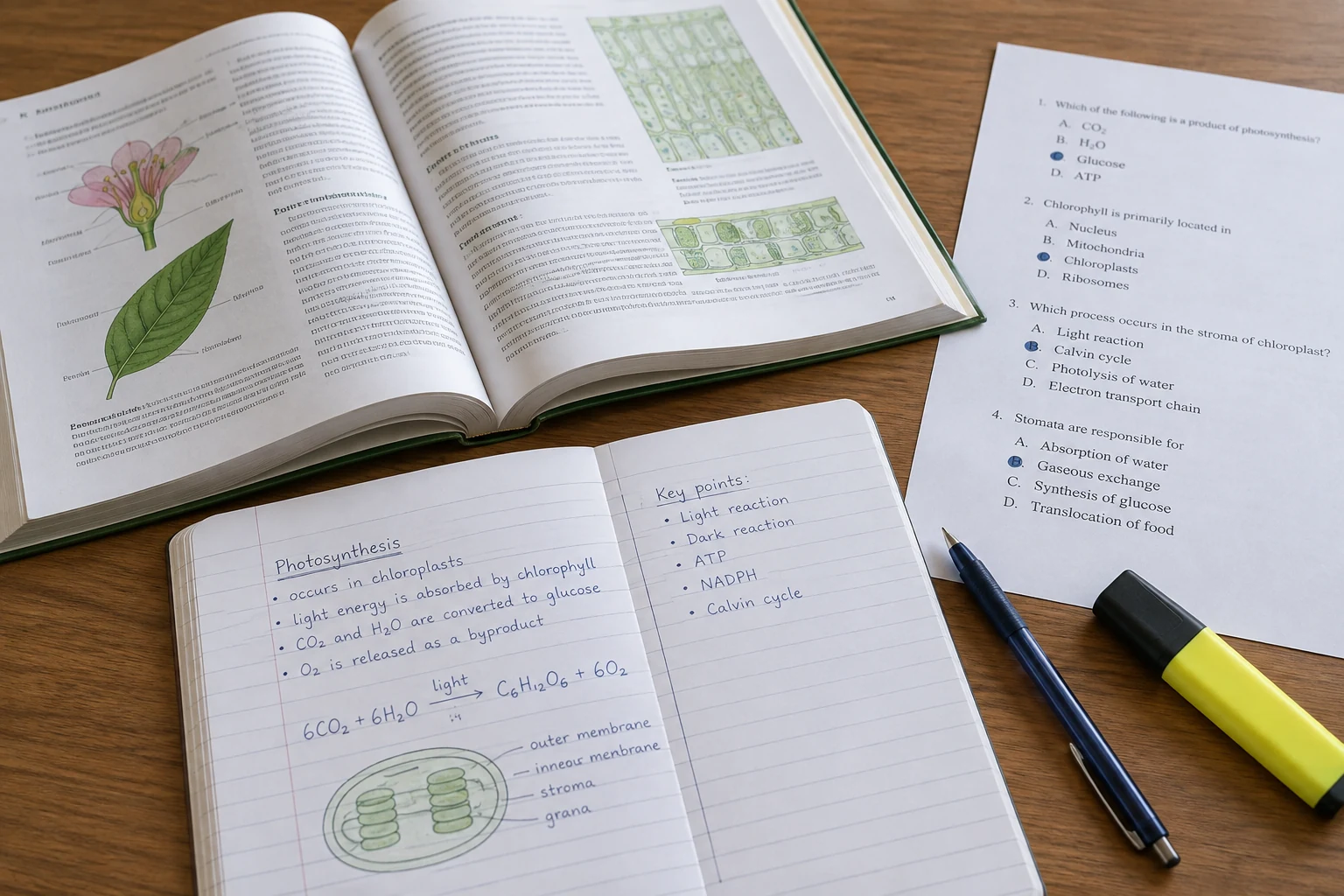
Your first job is still to understand the chapter properly. Learn the concepts taught in school. Read the relevant NCERT material. Complete the school work and clear anything you do not understand. But the learning does not have to stop there.
Once you understand the chapter, look at how the same concepts connect to the NEET syllabus and try relevant previous NEET questions. A school chapter can therefore become the foundation on which you build your NEET preparation.
- SCHOOL LEARNING
- UNDERSTAND THE NCERT CONCEPT
- CONNECT IT TO NEET
- TRY RELEVANT PYQS
- IDENTIFY WHAT STILL NEEDS REVISION
This is much more efficient than thinking that you must first "finish school Physics" and then separately begin "NEET Physics" from the beginning.
AIandMe follows this same idea by connecting relevant NEET syllabus items and available NEET PYQs to the Class 11 and Class 12 NCERT chapters and sections where those concepts are learnt. Viewing the actual mapped questions requires the relevant NEET access.
USE THE SAME LEARNING FOR NEET PRACTICE
AIandMe can help you continue from the chapter or section you have just studied. Where past NEET questions are available and your plan includes the relevant NEET access, you can view questions mapped to that learning area or take a NEET PYQ test focused on selected chapters or sections. You can also create an AI-generated test using selected chapters or sections when you want fresh practice.
AI-generated questions are fresh practice questions, not actual previous NEET questions.
Start with the time you actually have
A timetable drawn on paper can contain as many study hours as you want. Your real day cannot.
School, travel, meals, sleep and other responsibilities already occupy part of the day. Start with those realities rather than copying a timetable made by somebody whose life may be completely different from yours.
The useful question is not, How can I somehow study for eight more hours? It is, How can I use the study time I genuinely have as effectively as possible?
Research on time management supports taking this broader view. A large review combining 158 studies found that time management was moderately related to academic achievement and wellbeing and was negatively related to distress. Its relationship with wellbeing was stronger than its relationship with performance.
That matters because effective time management should not mean squeezing work into every available minute. A good plan should help you decide what deserves attention while making the overall workload more manageable.
Find the concentration pattern that works for you
Students are different. One student may be able to work with good concentration for an hour. Another may start losing attention after 20 minutes. Someone else may need a short reset after 15 minutes before beginning again.
There is nothing particularly valuable about keeping a book open for two hours if you stopped thinking properly after the first 30 minutes.
Learn to notice when you are actually working and when you are simply sitting at the table. If you have been struggling with a difficult Physics problem for some time and your concentration is falling, a short break may help. You might then do a lighter piece of Biology revision or finish a straightforward school task before returning to Physics.
This is not a fixed formula. Some students prefer longer uninterrupted periods. Others work better in shorter blocks.
Research on short breaks provides some support for using them sensibly. A 2022 meta-analysis found that short breaks were linked with slightly more energy and less fatigue, although they did not significantly improve overall performance across all tasks. Harder mental work may need a longer break than a very short pause.
So there is no scientifically perfect "20-minute", "30-minute" or "one-hour" study block that everyone should follow. Find a rhythm in which you can still think clearly.
MAKE ROOM FOR WHAT MATTERS
Decide what you need to do, learn and revise
When several things are demanding your attention at the same time, a simple way to organise them is:
DO
This is something that really has to be done soon. School homework that must be submitted tomorrow, a record that must be completed or preparation for tomorrow's school test may belong here.
These cannot simply be ignored because you would rather study another NEET topic.
LEARN
This is the work that moves your understanding forward. It might be the next NCERT section, today's Laws of Motion concept or a chapter that you have started but not yet properly understood.
This is different from merely completing written work.
REVISE
This is learning that you have already encountered but needs more attention. It may include a concept you are beginning to forget, an area where your test results are weak, an answer you guessed, a formula you could not recall or a question that showed that you had misunderstood something.
This distinction can prevent one common problem: spending the entire evening completing urgent work while learning and revision are continuously postponed.
A test is not finished when you receive the mark
Students often write a test, receive the answer paper, look at the score and move on. That throws away some of the most useful information the test produced.
- TEST
- REVIEW
- ASK
- REVISE
- TRY AGAIN
Take another 15 or 20 minutes with the paper. Look at the questions you got wrong. Also look at questions where you were unsure or guessed the answer, even if the answer happened to be correct.
Ask why. Did you not know the concept? Did you know it earlier but forget it? Did you misunderstand the question? Did you understand the concept but fail to apply it? Was it a careless mistake? Did you run out of time?
The answer determines what should happen next. If you did not understand something, go back to the concept. If you forgot it, revise it. If you could not apply it, try another question based on the same idea.
Most importantly, ask for help. Ask the teacher. Talk to a friend who understood the question well. Go back to the textbook. Work through another example. And where it is useful, ask AI.
Inside AIandMe's AI Study Room, Ask AI already knows the class, subject and chapter you are studying and, where relevant, the current section. Once enough recent learning activity exists, it may also use parts of your recent progress, quizzes and tests when helping you discuss what needs attention.
The aim is not simply to obtain the answer to the question you got wrong. It is to understand the idea well enough to answer the next question yourself. For a practical review routine, see how to learn from questions you got wrong or guessed.
A STUDENT IS STILL A PERSON
Keep your mind and body ready to learn
A study timetable sometimes contains only academic activities. That is not the whole life of a student.
Sleep, food, physical activity, play, friends, family and ordinary conversation are not automatically wasted time simply because they are not NEET preparation. The student who has to learn Physics, Chemistry and Biology is still a person.
- SLEEP — Protect time to rest.
- EAT & DRINK — Keep meals and water in your routine.
- MOVE & PLAY — Leave room for physical activity.
- FRIENDS & FAMILY — Stay connected to people.
Protect your sleep
Trying to create study time by repeatedly cutting sleep can be a poor trade.
The American Academy of Sleep Medicine recommends that teenagers aged 13–18 regularly get 8–10 hours of sleep per 24 hours. Its evidence review links adequate sleep with outcomes including attention, learning, memory, emotional regulation and physical and mental health.
This does not mean every teenager will fall asleep at exactly the same time or require exactly the same amount every night. It does mean that sleep should not be treated as the first disposable part of the timetable.
Eat and drink normally
Do not routinely skip a meal because another twenty minutes of study appears more valuable. Regular meals, adequate water and sensible food are basic parts of looking after the body that is being asked to attend school, concentrate, remember and work for long periods.
NEET preparation should not require students to neglect ordinary health.
Keep moving and playing
Sport, walking, outdoor games and other physical activity do not have to disappear when Class 11 or 12 becomes serious.
A large review bringing together 41 earlier systematic reviews and meta-analyses did not find that physical activity harmed academic achievement overall; the findings ranged from no effect to small positive effects.
That does not mean playing football will automatically increase a NEET score. It does mean there is little reason to assume that removing all physical activity is necessary for academic success.
Keep talking to people
Friends and family also matter. Normal conversations, laughter, spending some time with people you enjoy and maintaining good relationships are part of a healthy student life.
A systematic review of adolescent friendship research found associations between friendship quality and several aspects of wellbeing. That research does not show that spending more time chatting will improve examination marks; it does remind us that relationships are an important part of adolescent wellbeing.
Relationships can also become practical sources of help. The classmate who understood a difficult problem may explain it differently from the textbook. A teacher may identify the misunderstanding immediately. A parent may notice that a student is exhausted long before the timetable does.
NEET is important. It should not require a student to become isolated from everybody around them.
See what this can look like in a normal evening
Imagine a Class 11 student returning home with several things competing for attention. There is Mathematics homework due tomorrow. Physics at school has reached Laws of Motion, and today's concept still needs proper understanding. Yesterday's Chemistry test has come back with three questions wrong.
The student also wants some time to play, eat dinner with the family and sleep at a sensible time. There is no need to panic and label all of this "backlog". Use the framework.
DO
The Mathematics homework has a real deadline. Complete it.
LEARN
Continue Laws of Motion. Because school is already teaching the chapter, build on that learning instead of treating NEET Physics as a second unrelated subject. Understand the NCERT concept first. Once it is clear, try some relevant NEET PYQs and see how the same ideas have been used in examination questions.
REVISE
Return to the three Chemistry mistakes. They may need only 15 or 20 focused minutes tonight. Understand why they went wrong. If the concept is unclear, ask for help. If more work is needed, schedule another revision period rather than carrying an undefined feeling that "Chemistry is weak".
The exact order and minutes may be different for another student. That is the point.
Let your results change your plan
A good study plan is not fixed forever. If a test shows that a section is weak, tomorrow's plan may need to change. If a chapter that felt difficult begins becoming easier, you may be able to move forward. If school and NEET are covering the same concept, combine that work intelligently.
AIandMe's Study Plan can help show what learning remains within a chapter. Learning Insights can help you understand your progress and checked learning. Testing Insights can show patterns from Practice With AI, including areas and mistakes that may deserve attention.
These are sources of information, not commands. AIandMe does not know every part of your life. It does not automatically know that you have a school assignment tomorrow, that coaching ran late today, that you are tired or that there is something important happening in your family.
You still make the final decision about how to use your time. See how to decide what you should study next for ways to interpret the different learning and testing signals.
Build your week from evidence, not guilt
There will be days when you cannot complete everything you hoped to complete. That does not automatically mean that your preparation is failing. Instead of carrying every unfinished task as one large backlog, look at it again.
What must I do? What do I still need to learn? What should I revise because my results show that it needs attention? Then decide what realistically fits. Come back to the plan as the week changes.
NEET preparation takes place over months. A sustainable routine in which school learning, NEET practice, revision, sleep, health, physical activity and relationships can coexist is more useful than an impressive timetable that lasts for only a few days.
You may not always be able to create more study time.
References
-
Brad Aeon, Aïda Faber and Alexandra Panaccio (2021). Does time management work? A meta-analysis. PLoS ONE, 16(1), e0245066. PubMed record.
-
Patricia Albulescu, Irina Macsinga, Andrei Rusu, Coralia Sulea, Alexandra Bodnaru and Bogdan Tudor Tulbure (2022). "Give me a break!" A systematic review and meta-analysis on the efficacy of micro-breaks for increasing well-being and performance. PLoS ONE, 17(8), e0272460. PubMed record.
-
Shalini Paruthi et al. (2016). Recommended Amount of Sleep for Pediatric Populations: A Consensus Statement of the American Academy of Sleep Medicine. Journal of Clinical Sleep Medicine, 12(6), 785–786. PubMed record.
-
Ana Barbosa, Stephen Whiting, Philippa Simmonds, Rodrigo Scotini Moreno, Romeu Mendes and João Breda (2020). Physical Activity and Academic Achievement: An Umbrella Review. International Journal of Environmental Research and Public Health, 17(16), 5972. PubMed record.
-
Abdullah Alsarrani, Ruth F. Hunter, Laura Dunne and Leandro Garcia (2022). Association between friendship quality and subjective wellbeing among adolescents: a systematic review. BMC Public Health, 22, 2420. PubMed record.
About these references
These studies examine time management, breaks, adolescent sleep, physical activity and adolescent wellbeing in general. They were not studies of NEET students specifically. They support the broader principles discussed here and do not establish a perfect NEET timetable, one concentration period that suits everyone or guaranteed examination outcome.