



Finishing chapters, revising notes and solving large numbers of questions are all part of NEET preparation, but none of them alone tells you whether you are truly ready. A student may spend many hours studying and still have gaps in important syllabus areas, forget material that was learnt earlier, or struggle to apply a familiar concept when it appears in an unfamiliar question.
A more useful way to judge preparation is to look for evidence of syllabus coverage, memory and understanding. Readiness also depends on using ideas in new questions, handling previous NEET questions from the same area, learning from mistakes and remembering the material after some time has passed.
The following seven checks provide a practical way to answer those questions and decide what to work on next.
A PRACTICAL READINESS CHECK
Seven ways to check your NEET preparation
- Cover the complete syllabus
Compare the learning with what NEET requires.
- Check what you can remember
Bring back the important ideas without the book.
- Apply what you learnt
Use familiar concepts in unfamiliar questions.
- Practise with NEET PYQs
Check how the area has been tested before.
- Learn from mistakes
Match each learning gap to a useful next action.
- Check what still stays with you
Return after a gap and test the learning again.
- Choose what to study next
Use the evidence to direct the next study session.
A chapter is better prepared when you have covered what is required, can remember and use it, can learn from mistakes and can still recall it later.
1. Cover the complete NEET syllabus
Completing an NCERT chapter is an important milestone, but it does not automatically mean that every NEET syllabus point connected to that chapter has been covered. The first step in checking preparation is therefore to compare what you have studied with what the NEET syllabus actually expects.
For a chapter that you believe is complete, trace each relevant NEET syllabus point to the NCERT chapter and section where it is taught. This can reveal sections that were skipped, topics that were read too quickly, or material that was learnt earlier but has not been revised for some time.
AIandMe maps relevant NEET syllabus items to the Class 11 and Class 12 NCERT chapters and sections where those ideas are taught. This can make it easier to check whether there are parts of the syllabus that still need attention.
See how AIandMe helps you check whether a NEET syllabus item has really been covered and understood.
2. Check what you can remember without the book
A topic often feels familiar while the textbook is open because the words, diagrams and formulas are already in front of you. That feeling of familiarity can easily be mistaken for learning. A better check is to close the book and see what you can bring back from memory.
A closed-book check makes the gaps easier to see. Difficulty recalling an idea does not mean the study session was wasted; it tells you which parts need another round of learning or revision. Keep the check short and specific:
- Explain the concept in your own words.
- Write the important formula or list the key facts.
- Draw or label the important diagram.
- Recall the main steps of a process.
What research tells us
Research on learning supports this approach. In a 2006 study, students who repeatedly tested themselves remembered more on delayed tests than students who repeatedly studied the same material, even though repeated studying could make learners feel more confident.
3. Test whether you can apply what you learnt
Remembering a definition or formula is useful, but NEET also requires students to recognise when and how that knowledge should be used. A topic is therefore better prepared when you can apply it to a question that you have not already seen.
An unfamiliar question forces you to decide which concept is relevant, choose the correct formula or principle, connect different ideas and work out why a particular answer is correct. This is different from recognising the answer to a question that has already become familiar through repeated practice.
Research has also shown that testing can help learners use studied information in new questions, rather than only remember the exact material they practised. Butler's 2010 study examined this transfer of learning after repeated testing.
Read the research on testing and new questions.
TRY IT IN AIANDME
Try fresh questions
AIandMe's Practice With AI allows students to create AI-generated tests using selected chapters or sections. This can be useful when you want to test one particular area with fresh questions instead of relying only on questions you have already encountered.
Learn how to create an AI-generated test in AIandMe.
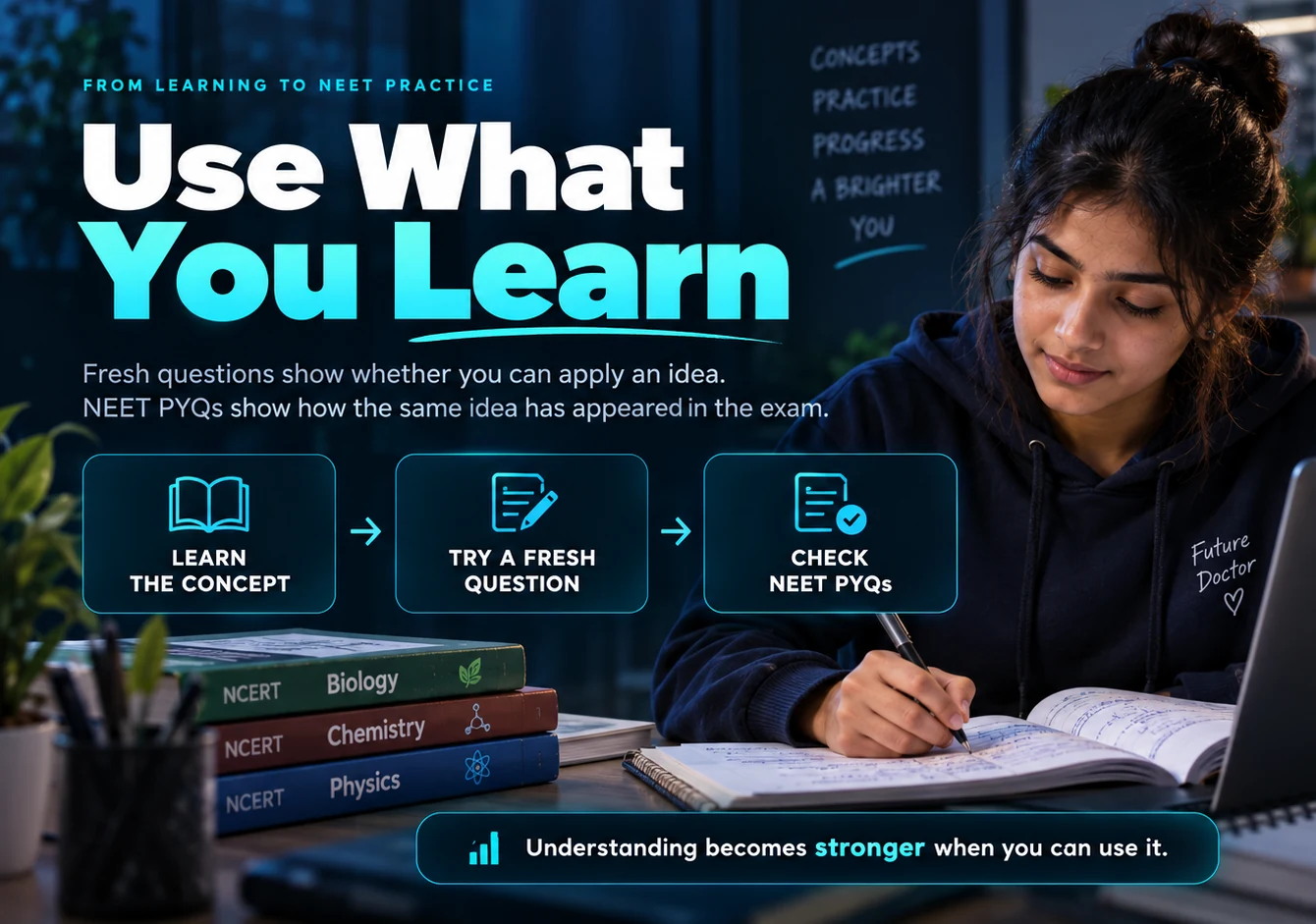
4. Use NEET PYQs to check exam-level understanding
Fresh questions help check whether a concept can be applied. Previous Year Questions, or PYQs, provide another kind of evidence: they show how the same ideas have actually appeared in earlier NEET examinations.
After learning a section, past questions can help you see how NEET frames the concept, which relationships or facts have been tested, and whether you can recognise the idea when it appears in an exam-style question. They can also expose repeated misunderstandings that may not be obvious while reading the textbook.
AIandMe connects available past NEET questions to the NCERT chapters and sections to which they relate. Comparing these questions with the learning area helps connect textbook understanding to exam-level practice.
Where the student's plan includes the required NEET access, a NEET PYQ test can also be created for selected chapters or sections.
Past questions are valuable evidence of how topics have been tested before, but they should not be treated as predictions of the next examination.
See how to use NEET PYQs while learning a chapter.
Learn how to set up a NEET PYQ test.
CONNECT LEARNING TO THE EXAM
Follow the concept from NCERT to NEET practice
- NCERT SECTION
Where the concept is learnt and explained in the textbook.
- NEET SYLLABUS ITEM
What the current NEET syllabus expects the student to know from that area.
- MAPPED NEET PYQs
How available previous NEET questions have tested the same area.
The goal is not only to finish a chapter, but to understand what NEET expects from that part of it.
5. Use mistakes to decide what needs more work
A wrong answer is most useful when you understand why it went wrong. Simply checking the correct option and moving to the next question may fix that one question, but it may leave the real learning gap unchanged.
| What happened? | What to do next |
|---|---|
| I didn't know it | Learn that part properly. |
| I forgot it | Revise it and try to remember it again later. |
| I didn't understand it properly | Go back to the concept and work through it slowly. |
| I knew it, but couldn't use it in the question | Try different questions on the same idea. |
| I made a careless mistake | Find the pattern and watch for it in the next test. |
| I ran out of time | Practise similar questions with a time limit. |
This is why a disappointing test score can still be valuable. The result can show exactly where the next study session should be spent.
Use Ask AI when a concept still does not make sense
When the reason for a mistake is not clear, Ask AI can provide contextual help inside AI Study Room. It already knows the class, subject and chapter being studied and, where relevant, the current section. It can provide follow-up help on just the part that remains confusing. Simple questions are enough to begin:
- “Why is this answer correct?”
- “Can you explain this in a simpler way?”
- “What is the difference between these two ideas?”
- “I understand the first part but not the next step.”
Once enough recent learning activity is available, Ask AI can also use parts of the student's recent chapter progress, quizzes and tests to help discuss areas that may need more attention. The purpose is not simply to obtain an answer, but to understand enough to answer the next question yourself.
6. Check whether the learning lasts
Getting a question right immediately after studying is encouraging, but NEET preparation takes place over many months. What matters is whether the learning is still available when you return to it later.
- LEARN
- TEST
- WAIT
- REVISE
- TEST AGAIN
A good result today is useful. A good result again after a gap tells you much more.
If a topic that felt easy today becomes difficult again after a week, it probably needs more revision. If you can still explain it and answer questions after a gap, that provides stronger evidence that the learning is becoming more secure.
Research on learning over time
Research on spaced learning has repeatedly found that spreading study across different sessions can improve longer-term retention compared with concentrating the same study close together. A large 2006 review by Cepeda and colleagues brought together hundreds of experiments on this effect, while a broader review of common learning methods identified both practice testing and distributed study as particularly useful approaches.
This does not mean there is one perfect revision timetable for every student. A topic should not be permanently marked as finished because it went well once; returning to it later shows whether more revision is needed.
7. Turn the results into the next study action
The purpose of checking preparation is not simply to find weaknesses. It is to decide what to do next.
Most study decisions can be placed into four simple actions:
LEARN
Work on something that has not yet been learnt properly.
REVISE
Return to something learnt earlier that may be fading.
FIX
Work on something a quiz or test has shown to be weak.
TEST AGAIN
Check whether the additional learning or revision helped.
LEARN → REVISE → FIX → TEST AGAIN
AIandMe provides a Study Plan for each chapter, breaking the chapter into smaller learning days and topics. This helps students see what has not been started, what is currently in progress and what has already been completed.
However, progress and understanding are different. Completing a Study Plan shows that the planned learning has been worked through; quizzes, tests, PYQs and fresh practice provide additional evidence about how well that learning can actually be used.
When the next step is unclear, Ask AI can help discuss what recent work in the current chapter is showing, once enough recent learning activity is available.
A practical one-chapter readiness check
There is no need to audit the entire NEET syllabus in one evening. A better approach is to begin with one chapter that you believe is already well prepared and test that assumption carefully.
- Check the NEET syllabus points connected to the chapter.
- Check the NCERT sections where those ideas are taught.
- Identify anything that has not been learnt or revised properly.
- Close the book and see what can be recalled.
- Take a short test on one section.
- Try the available NEET PYQs from that area.
- Review every wrong or guessed answer.
- Return to anything that needs to be learnt, revised or fixed.
- Come back after a few days and test the area again.
Preparedness is more than chapter completion
There is no single number that can prove that a student is completely ready for NEET. Preparation is built from several kinds of evidence: syllabus coverage, memory, understanding, application, performance on relevant questions, the ability to learn from mistakes and the ability to retain learning over time.
Hours studied and chapters completed are useful measures of effort, but they do not tell the whole story. A stronger measure is whether the learning can still be remembered, understood and used when it is needed.
Start with one chapter, find the gaps, work on them and check again. Repeating that process across the syllabus gives a much clearer picture of preparation than simply counting completed chapters.
For a broader AIandMe routine that connects learning, practice, results and revision, see How AIandMe can help you prepare systematically for NEET.
References
-
Henry L. Roediger III and Jeffrey D. Karpicke (2006). Test-enhanced learning: Taking memory tests improves long-term retention. Psychological Science, 17(3), 249–255. DOI: 10.1111/j.1467-9280.2006.01693.x. PubMed record.
-
Nicholas J. Cepeda, Harold Pashler, Edward Vul, John T. Wixted and Doug Rohrer (2006). Distributed practice in verbal recall tasks: A review and quantitative synthesis. Psychological Bulletin, 132(3), 354–380. DOI: 10.1037/0033-2909.132.3.354. PubMed record.
-
John Dunlosky, Katherine A. Rawson, Elizabeth J. Marsh, Mitchell J. Nathan and Daniel T. Willingham (2013). Improving Students' Learning With Effective Learning Techniques: Promising Directions From Cognitive and Educational Psychology. Psychological Science in the Public Interest, 14(1), 4–58. DOI: 10.1177/1529100612453266. PubMed record.
-
Andrew C. Butler (2010). Repeated testing produces superior transfer of learning relative to repeated studying. Journal of Experimental Psychology: Learning, Memory, and Cognition, 36(5), 1118–1133. DOI: 10.1037/a0019902. PubMed record.
About these references
These are studies and reviews about learning and memory in general. They were not studies of NEET students specifically.
We use them here for the learning principles they examine, such as remembering without looking, practising with questions and returning to learning after a gap. They do not guarantee a particular NEET result.