


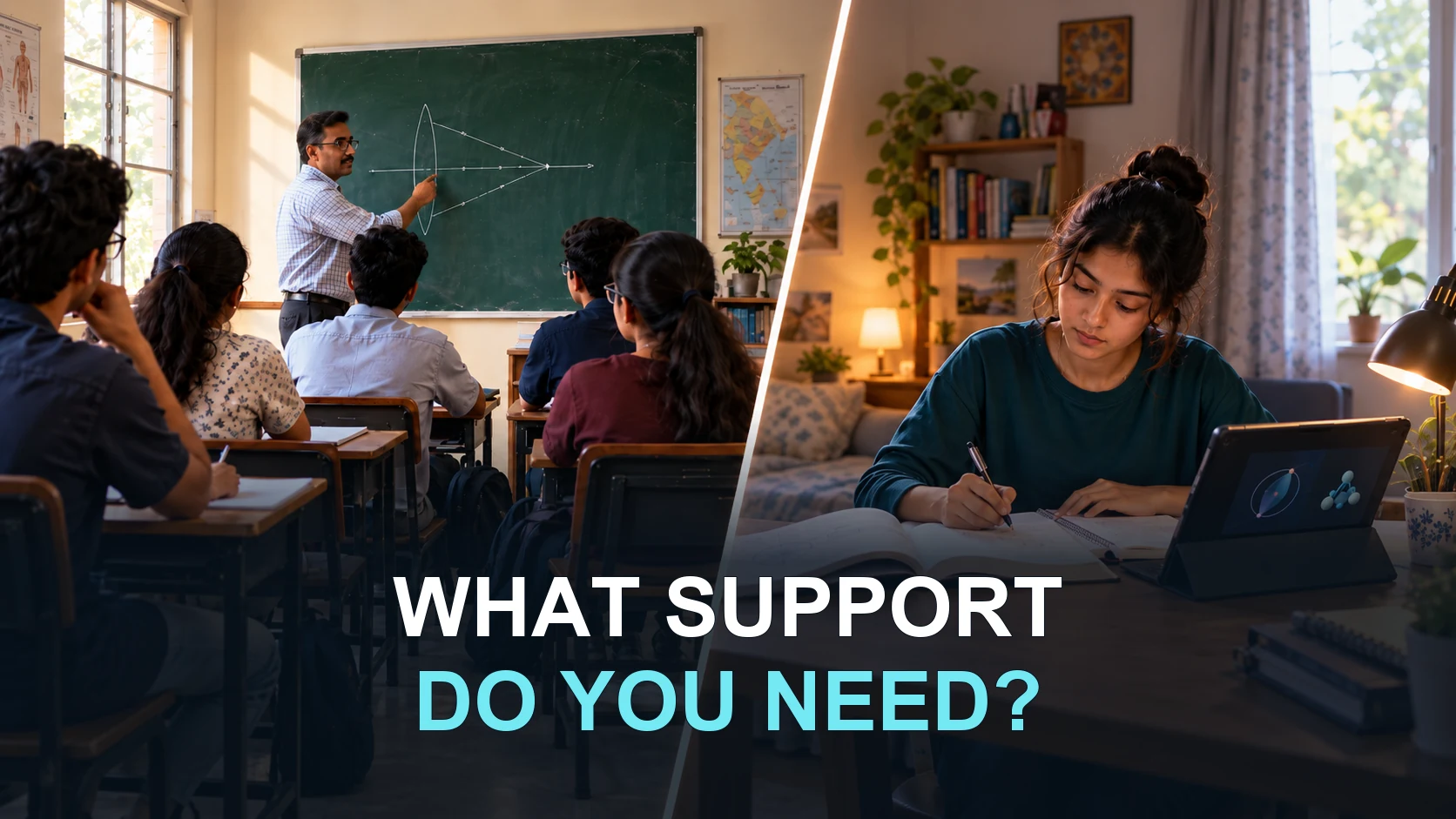
For many students and parents, NEET preparation seems to begin with one question:
Which coaching centre should I join?
For years, physical coaching was one of the most practical ways to get additional teaching, a structured timetable, regular tests and support outside school. And for many students, a good coaching centre can still be extremely valuable.
But students today have another option.
A personalised self-learning platform can provide explanations, practice, testing, feedback, revision support and guidance around the individual student's learning. It does not necessarily require another fixed classroom or another four-hour timetable after school.
So perhaps the question is no longer simply:
“Should I take coaching or study on my own?”
A better question is:
What support do you need?
That means asking what kind of help would actually make your NEET preparation better.
And importantly, the answer does not always have to be one or the other.
For some students, personalised self-learning can become the main NEET preparation system alongside school. For others, it can sit alongside coaching and make the student's individual work between classes much more focused.
Coaching and self-learning solve different problems
PHYSICAL COACHING
A group timetable and teacher-led sequence at a fixed place and time. Face-to-face interaction, peers and external accountability can help students who need classroom structure.
PERSONALISED SELF-LEARNING
An individual pace with more flexible time and place. Learning evidence and contextual digital help can guide attention, but the student needs greater self-direction.
A good coaching centre can provide something very valuable: structure.
There is a timetable. A teacher decides what will be taught. Classes happen at fixed times. Tests are scheduled. Other students are preparing for the same examination. There is an external system continuously moving the student forward.
Some students thrive in that environment.
But even the best coaching class normally teaches a group.
The teacher may explain Current Electricity very well to forty students. At the end of the class, however, those forty students have not necessarily learnt the same thing.
One student understood almost everything.
Another did not understand Kirchhoff's rules.
Someone else understood the theory but cannot solve the questions.
Another student thinks they understood it but discovers during a test that they did not.
That individual learning happens after the teaching.
Coaching can teach the class. Self-learning is where the student turns that teaching into their own understanding.
This is why coaching and personalised self-learning do not have to compete with each other.
They can solve different parts of the same preparation problem.
What do we mean by personalised self-learning?
It is important to distinguish personalised self-learning from simply being left alone with books and YouTube.
Traditional self-study often places almost every decision on the student.
What should I study today?
Which explanation should I use?
Which questions should I solve?
What should I revise?
Why did I get that question wrong?
Am I spending too much time on one chapter?
What should I do next?
A capable and experienced student may handle all of this very well. Many students, however, need some support around these decisions.
A personalised learning system can potentially provide that support while leaving the student in control of their own learning.
The student still studies.
The student still thinks.
The student still solves the question.
The student still has to put in the effort.
What changes is the amount of useful information available around that effort.
Personalised self-learning should not mean that a computer does the learning for you. It should mean that the support around your learning responds increasingly to what you actually need.
That distinction matters.
When physical coaching may be the better fit
Physical coaching can be particularly useful when the student needs strong external structure.
Perhaps studying independently is currently difficult. A fixed class forces the student to begin at a particular time rather than postponing the work until later.
A physical classroom also provides direct access to teachers. A student can raise a hand, ask a question and have a face-to-face conversation.
There is also the social environment. Seeing other students working seriously can create momentum and accountability. Some students enjoy this and perform better when they are part of a group.
For a student who needs:
a fixed routine, regular classroom teaching, external accountability, direct teacher interaction and a competitive peer environment,
good coaching may be a very sensible choice.
There is nothing outdated about needing structure.
The mistake would be assuming that every student needs exactly the same structure.
When personalised self-learning may be enough on its own
Now consider a student who already attends a good school.
Their Physics, Chemistry and Biology are being taught regularly.
They are reasonably disciplined.
They can sit down and study without another adult constantly supervising them.
What they are missing may not be another complete set of lectures.
They may need:
better NEET-focused practice,
help when a concept is unclear,
past NEET questions connected to what they are learning,
tests,
feedback,
revision guidance,
and a clearer picture of strengths and weaknesses.
For that student, adding another fixed classroom may duplicate a lot of teaching they already receive.
A personalised self-learning platform can potentially fill the missing pieces without creating a second school day.
This connects closely with our earlier article on balancing NEET preparation with regular school. The question is not how many academic activities can be fitted into one day. It is how to make school learning and NEET preparation reinforce each other.
A classroom has to move with the group
This is one of the fundamental differences between classroom learning and personalised learning.
Imagine a coaching class teaching Chemical Bonding.
The teacher cannot reasonably create forty separate lessons during the same hour.
The class has to move together.
But the students are not identical.
One may already understand the chapter from school and need only NEET-level practice.
Another may need a different explanation.
Another may have forgotten an earlier concept that this chapter depends on.
Someone else may be ready to move ahead.
A classroom teacher can certainly help individual students, but there is a practical limit to how individually a large class can continuously adapt.
A personalised system has a different opportunity.
The biggest difference is not where the learning happens. It is whether what happens next can change for the individual student.
That is where personalisation becomes genuinely useful. Evidence and guidance can help the student choose a different next action; this does not mean that AIandMe automatically changes every lesson or Study Plan.
Personalised learning can reduce unnecessary repetition
Suppose your school has already taught Laws of Motion well.
You understand it.
You have completed the school work.
You can explain the important ideas.
Do you necessarily need to watch another five hours of lectures on Laws of Motion simply because the coaching programme has reached that chapter?
Perhaps not.
You may get more value from moving directly into NEET questions and discovering whether your understanding survives application.
On the other hand, if those questions reveal that friction or circular motion is still unclear, that is where more learning time becomes valuable.
The aim is not to study less for the sake of studying less.
It is to spend more time where the evidence says the time is needed.
That is a very different approach from measuring seriousness by the number of hours spent sitting in classes.
Even coaching students still need self-learning
This may be the most important point in the whole comparison.
Suppose a student attends excellent NEET coaching.
They finish class at 6:00 p.m.
The teacher has explained Electrostatics well.
The student goes home.
What happens now?
The individual work still remains.
Did I actually understand today's class?
Can I solve questions without the teacher?
Which part did I misunderstand?
Was that answer correct because I knew it, or because I guessed?
Am I taking too long to solve numerical questions?
What should I revise from last month?
Is this weakness appearing repeatedly in my tests?
A coaching centre cannot sit beside every student individually throughout the evening.
This is where a personalised self-learning platform can add considerable value even to someone already attending coaching.
Coaching does not remove the need for self-learning. Good coaching can actually make good self-learning more valuable, because the student can consolidate and personalise what was taught in class.
That gives us a very useful hybrid model.
The hybrid approach: coaching plus personalised self-learning
A student does not necessarily have to choose:
coaching OR technology.
The learning journey can look like this:
- CLASS
- UNDERSTAND
- PRACTISE
- REVIEW / REVISE
- RETURN STRONGER
Learn Electrostatics with the teacher, then check whether you actually understood it. Practise questions connected to the class and ask about the particular doubt that remains. Test yourself without help, review wrong, guessed and slow answers, and revise the areas that need attention. Return to the next class with a stronger foundation.
Now the two systems are reinforcing each other.
Coaching provides group teaching and structure.
Personalised self-learning provides an individual layer around that teaching.
This is fundamentally different from simply adding another app on top of coaching.
The additional tool must solve a problem. Using AIandMe around coaching means using it during your own learning and review time; it does not imply a formal integration with a coaching centre.
More support is not automatically better
There is an important danger here.
A student can easily end up with:
school,
coaching,
one learning platform,
another question bank,
YouTube channels,
a separate test series,
Telegram groups,
and three sets of notes.
At that point, the problem is no longer lack of resources.
It is deciding which one to use.
More learning resources do not automatically produce more learning.
Every part of the student's preparation should have a reason to exist.
What is school providing?
What is coaching providing?
What remains missing?
What does the personalised platform add that those systems do not already provide?
If you cannot answer that clearly, you may simply be increasing workload.
Where personalised self-learning can be stronger
A personalised approach has several natural advantages when it is designed well.
It can move at the student's pace
A student can spend longer on something difficult without making thirty-nine other students wait.
Equally, something already understood does not necessarily need to be repeated simply because the class timetable says so.
Help can be available while the student is actually studying
Doubts do not always appear during class.
They often appear later, while the student is working independently.
The ability to ask a contextual question at that moment can make self-learning much easier.
Practice can follow learning immediately
The student can learn something and then test that understanding rather than waiting until the next scheduled test.
This creates a tighter connection:
learn → practise → review → correct
Tests can produce individual evidence
The same test score can hide very different problems.
One student may have a concept gap.
Another may repeatedly guess.
Another may be accurate but slow.
Another may simply be weak in one chapter.
The more precisely those differences can be identified, the more useful the next study decision can become.
In AIandMe tests, Guessed is a marker you select while answering, not a diagnosis inferred from an external mock paper. Pacing uses active foreground question time rather than hidden or inactive time; extreme timings are capped in summaries. Revision can bring back eligible questions whose latest completed attempt was wrong or marked Guessed, with chapter and section filters. Unanswered questions are not included, and a later confident correct attempt can remove a question from that pool. These signals help you decide what to review; they do not explain every mistake by themselves.
This is the same principle behind our article on how to choose the right NEET preparation platform: real personalisation should influence what happens next, not merely put the student's name on a dashboard.
Where personalised self-learning can fail
Flexibility has a weakness.
Nobody forces you to use it.
A personalised platform can be available twenty-four hours a day and still be useless if the student never opens it.
Self-learning can be a poor primary choice when the student currently struggles to maintain a routine without external supervision.
It may also be difficult when:
the home environment is unsuitable for study,
the student consistently procrastinates,
face-to-face teacher interaction is particularly important to them,
or the student keeps collecting learning resources without actually completing meaningful work.
Flexibility is valuable only when the student uses it.
This is why there cannot be one answer for every NEET aspirant.
A student's current ability to manage their own learning matters.
And that ability can develop over time.
Learning independently is itself an important skill
NEET is a major examination, but it is not the end of the student's learning journey.
For a successful student, it is the beginning of a much longer one.
Medicine requires enormous amounts of independent learning.
Students eventually have to identify what they do not know, find good information, evaluate their understanding, revisit weak areas and continue learning without someone continuously organising every hour for them.
SELF-REGULATED LEARNING
Educational research describes this more broadly as self-regulated learning: students planning, monitoring and reflecting on their own learning rather than operating only through external direction. Reviews of the field describe self-regulated learning as involving cognitive, metacognitive, behavioural and motivational processes, and research has found meaningful relationships between these strategies and academic learning. Panadero's review
Li and colleagues' meta-analysis found a small overall association between self-regulation and academic performance in Chinese primary and secondary students, with task strategies and self-evaluation among the stronger associations. Most included studies were cross-sectional, so this is not proof that a strategy causes better scores, nor direct evidence about NEET preparation. Read the study
That does not mean students should receive no guidance.
Quite the opposite.
The aim should be to provide enough guidance for the student to become increasingly capable of directing their own learning.
Good educational support should not make the learner permanently dependent on support.
That is another reason personalised self-learning can be valuable even when coaching is present.
What does research say about technology-supported personalised learning?
There is a useful body of research on intelligent tutoring systems, although it should not be confused with evidence about AIandMe specifically or with modern generative AI.
INTELLIGENT TUTORING AND BLENDED LEARNING
A 2014 meta-analysis by Ma and colleagues examined 107 effect sizes involving 14,321 learners, from elementary to postsecondary education. Intelligent tutoring systems were associated with better achievement than large-group teacher-led instruction, non-intelligent computer instruction and textbook/workbook learning in the included studies. Importantly for the hybrid argument, positive effects were found both when these systems were used as the primary form of instruction and when they supplemented teacher-led instruction or homework. The authors did not find a significant difference compared with individualised human tutoring or small-group instruction. A non-significant difference is not proof of equivalence. See reference 3.
A separate 2016 meta-analysis by Kulik and Fletcher reviewed 50 controlled evaluations and also reported positive average effects, while stressing that outcomes depended substantially on the quality of implementation and how closely assessments matched instructional objectives. Its school, higher-education and training settings were varied, not an Indian NEET sample. See reference 4.
These studies are not NEET trials, and they are not proof that any app labelled “AI” will improve results.
A major meta-analysis by Means and colleagues found modestly better average outcomes for online conditions than face-to-face instruction overall, with the advantage statistically significant for blended rather than purely online comparisons. But the authors also warned that blended programmes often included additional learning time, resources and interaction, making it difficult to attribute the difference simply to the delivery medium. The 45 studies contributed 50 effects, with study-average learner ages ranging from 13 to 44 across college-or-earlier education, graduate programmes and professional training. These were not NEET or AIandMe trials. See reference 5.
They support a more careful point:
Technology can support individualised learning effectively when the system genuinely responds to the learner and is well integrated into the learning process.
Simply adding a chatbot or recommendation panel does not create personalisation.
Hybrid learning can also be a legitimate model
The blended-learning findings above give another useful caution when comparing online and face-to-face support.
That is useful for our question because it prevents an oversimplified conclusion.
The important thing is probably not:
offline good
or:
online good
or:
AI good.
The more meaningful questions are:
What learning does the student need?
What support does each part of the system provide?
Are those parts working together?
Three sensible NEET preparation models
This leaves us with three legitimate approaches.
- SCHOOL + SELF-LEARNING
May fit when school teaching is strong and independent practice can be sustained.
- SCHOOL + COACHING
May fit when direct classroom teaching and external structure are needed.
- SCHOOL + COACHING + SELF-LEARNING
May fit when each part fills a distinct gap without overloading the student.
School + personalised self-learning
This can work well for a student who receives a good teaching foundation through school, has reasonable study discipline and mainly needs NEET-focused practice, feedback, revision, contextual help and personalised direction.
For that student, another complete classroom schedule may not be necessary.
School + NEET coaching
This may be right for a student who particularly benefits from scheduled teaching, direct classroom interaction, external structure and accountability.
Self-study still remains necessary, but coaching provides the main preparation framework.
School + coaching + personalised self-learning
This can be extremely useful when each element has a clear purpose.
School provides the academic foundation.
Coaching provides additional structure and competitive-exam teaching.
Personalised self-learning helps the student turn both into their own understanding through targeted practice, doubt resolution, testing, revision and individual feedback.
The key is not to pile all three on top of the student.
It is to make them work together.
So which approach should you choose?
Start with the student rather than the institution.
Ask:
Does the student need another teacher, or more individual practice?
Do they need stronger external discipline?
Are school explanations already good enough?
Can they study independently?
Are doubts being resolved?
Are test mistakes being understood?
Is revision systematic?
Does the student know where their weak areas are?
Is coaching helping but leaving a gap between classes?
Is the student spending so many hours in scheduled teaching that there is little time left for independent thought?
Those answers matter much more than whether one method is generally described as “better”.
If the student needs strong classroom structure and direct supervision, physical coaching can provide real value.
If the student already has good teaching and can learn with reasonable independence, personalised self-learning may provide the additional NEET support they need without creating another classroom.
And if the student already attends coaching, personalised self-learning can provide an individual layer around it that a group class cannot continuously provide.
The right preparation model is the one that fills the student's actual learning gaps without unnecessarily duplicating what is already working.
HOW AIANDME CAN FIT EITHER APPROACH
AIandMe can serve as a personalised NEET self-learning option alongside school, or as an individual learning layer around coaching, depending on the student's needs, discipline and available access. AI Study Room connects NCERT learning with NEET context and mapped past questions where available; Ask AI supports chapter questions and follow-ups; Study Plan organises chapter learning; and Practice With AI supports practice, tests and eligible revision. Learning Insights shows AI Study Room progress and checked learning, while Testing Insights looks across completed Practice With AI tests. NEET Stats adds past-question priorities and stored Mentor AI NEET Insight for eligible students, not a universal standalone Mentor pane. Chapter Workspace provides Interactive Visuals for supported lessons when available; not every lesson has one. These tools support decisions, not an automatically rewritten timetable or a promise to replace a good teacher.
The question is bigger than coaching versus self-study
Perhaps the most useful way to think about this is not:
“Should I join coaching?”
or:
“Can I prepare without coaching?”
Instead ask:
“Do I have all the support I need to learn, practise, test, revise and keep improving?”
If the answer is yes, the exact combination may matter less than people think.
For one student, that combination may be school and personalised self-learning.
For another, it may include physical coaching.
For another, coaching and personalised AI-supported learning may work together.
What matters is that each part solves a real problem.
And whatever path you choose, remember that the student eventually has to do something no coaching centre, teacher or platform can do for them:
learn.
The best system is the one that helps them do that increasingly well for themselves.
References
- Panadero, E. (2017). A Review of Self-regulated Learning: Six Models and Four Directions for Research. Frontiers in Psychology, 8, 422. DOI: 10.3389/fpsyg.2017.00422. Panadero's review
- Li, J., Ye, H., Tang, Y., Zhou, Z., & Hu, X. (2018). What Are the Effects of Self-Regulation Phases and Strategies for Chinese Students? A Meta-Analysis of Two Decades Research of the Association Between Self-Regulation and Academic Performance. Frontiers in Psychology, 9, 2434. DOI: 10.3389/fpsyg.2018.02434. PubMed
- Ma, W., Adesope, O. O., Nesbit, J. C., & Liu, Q. (2014). Intelligent Tutoring Systems and Learning Outcomes: A Meta-Analysis. Journal of Educational Psychology, 106(4), 901–918. DOI: 10.1037/a0037123.
- Kulik, J. A., & Fletcher, J. D. (2016). Effectiveness of Intelligent Tutoring Systems: A Meta-Analytic Review. Review of Educational Research, 86(1), 42–78. DOI: 10.3102/0034654315581420.
- Means, B., Toyama, Y., Murphy, R., & Baki, M. (2013). The Effectiveness of Online and Blended Learning: A Meta-Analysis of the Empirical Literature. Teachers College Record, 115(3), 1–47. DOI: 10.1177/016146811311500307.
About these references
These studies explain broad learning principles across different educational settings. They do not compare NEET coaching with AIandMe, evaluate modern generative AI as a whole, or establish a guaranteed benefit for an individual student. The visible DOIs identify the publisher papers; the two PubMed links remain within the existing native article link policy.